Brainspotting
Educational Resource

Brainspotting
A powerful, focused treatment method that uses fixed eye positions to access, process, and release trauma stored deep in the subcortical brain. Developed by David Grand, Ph.D., BSP works with the brain-body connection through the visual system.
Developed by David Grand, Ph.D. (2003)

CEUs are being negotiated. Post-tests, certificates, and CE credit are not currently available.
Brainspotting: A Neurobiological Approach to Trauma Treatment
Target Audience: Licensed mental health professionals (psychologists, clinical social workers, licensed professional counselors, marriage and family therapists)
Brainspotting is a powerful, brain-body based therapy developed by David Grand, Ph.D., that accesses the deep brain's self-healing capacities. It emerged from his work with EMDR and Somatic Experiencing, recognizing that "where you look affects how you feel." The theoretical foundation of Brainspotting lies in its ability to access, process, and release core neurophysiological sources of emotional and physical pain. By using specific eye positions, or Brainspots, that correlate with internal felt-sense experiences, therapists can tap into the subcortical brain, particularly the amygdala, hippocampus, and periaqueductal gray, facilitating the resolution of traumatic memories and symptoms. This process is enhanced by the use of BioLateral sound, which promotes integration between the brain's hemispheres.
What makes Brainspotting a unique and effective approach for trauma treatment is its emphasis on Dual Attunement – the therapist's attunement to both the therapeutic relationship and the client's neurobiological processes. This relational and neurobiological attunement creates a safe container for the client to explore and process traumatic material that is often held in the non-verbal, subcortical areas of the brain. Key techniques include Inside Window and Outside Window Brainspotting, One-Eye Brainspotting for complex trauma and dissociative clients, and Resource Brainspotting to build internal resources and resilience. These methods allow for a precise and tailored approach to address a wide range of trauma-related symptoms, including anxiety, depression, dissociation, and somatic complaints.
The evidence base for Brainspotting is growing, with studies demonstrating its efficacy in treating PTSD, anxiety, and other trauma-related disorders. This module will deepen the clinician's understanding of the neurobiological underpinnings of Brainspotting, including the role of the spinothalamic tracts and thalamocortical processing in how the brain processes and releases trauma. Participants will learn to differentiate Brainspotting from other trauma therapies like EMDR, and gain practical skills to begin integrating this powerful modality into their clinical practice. By the end of this course, clinicians will be equipped to use Brainspotting to help clients access their innate healing capacities and achieve lasting recovery from trauma.
Upon completion of this module, the learner will be able to:
- 1Identify the key theoretical principles of Brainspotting, including the role of eye position and subcortical brain activity.
- 2Describe the concept of Dual Attunement and its importance in the therapeutic process.
- 3Differentiate between Inside Window, Outside Window, and One-Eye Brainspotting techniques.
- 4Explain the neurobiological mechanisms underlying Brainspotting, including the function of the spinothalamic tracts and thalamocortical processing.
- 5Apply Resource Brainspotting techniques to help clients build internal resources and resilience.
CEUs are being negotiated. Post-tests, certificates, and CE credit are not currently available. The course overview and learning objectives are available now for educational use. Planned contact hours for this module: 2.
Featured Video
An interview with Dr. David Grand, developer of Brainspotting, discussing the approach and its neurobiological foundations.
What is Brainspotting?
See also: Window of Tolerance - a foundational concept across all trauma modalities.
Brainspotting (BSP) is a brain-body therapy that uses fixed eye positions to access, diagnose, and process trauma stored in the subcortical brain. Discovered by David Grand, Ph.D. in 2003, BSP is based on the principle that "where you look affects how you feel."
"Brainspotting is based on the profound attunement of the therapist with the patient, finding a somatic cue and extinguishing it by down-regulating the amygdala."
~ Robert Scaer, MD
Discovery & Development
The Discovery (2003)
David Grand, Ph.D., discovered Brainspotting while working with EMDR. He noticed that clients' eyes would naturally stop at certain positions during bilateral stimulation, and that maintaining these positions led to deeper processing than the moving eyes of EMDR.
This observation led to the development of a new approach: instead of moving the eyes bilaterally, BSP uses fixed eye positions to access and process trauma stored in the subcortical brain.
Evolution of the Method
- Emerged from EMDR practice in 2003
- Development of multiple techniques (Inside Window, Outside Window, Gazespotting)
- Integration of biolateral sound for enhanced processing
- Expansion to sports performance, creativity, and other applications
- Growing international training network
BSP vs EMDR
| Aspect | Brainspotting | EMDR |
|---|---|---|
| Eye Movement | Fixed position | Bilateral movement |
| Structure | Flexible, client-led | 8-phase protocol |
| Processing | Open-ended | More structured |
| Therapist Role | Following, attuned | More directive |
| Training | 2-phase training | More extensive |
| Research Base | Growing | Extensive |
| Best For | Deep processing | Specific memories |
Neuroscience & How It Works
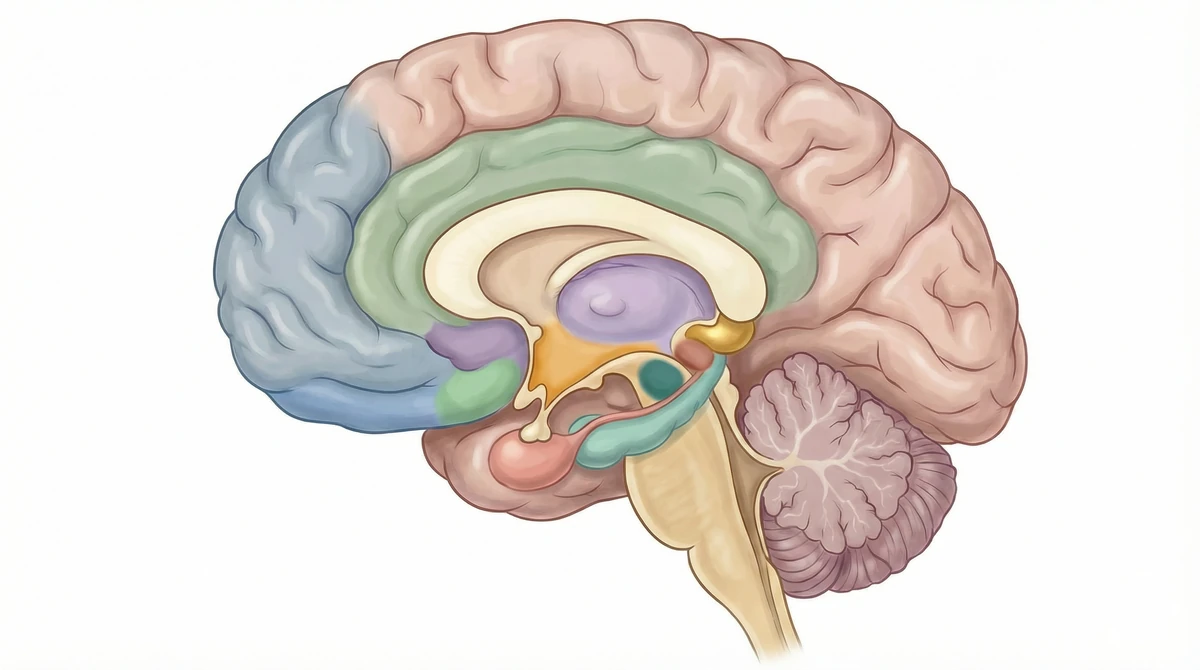
Understanding the brain regions targeted by Brainspotting helps clinicians appreciate how fixed eye positions access deep subcortical processing.
Brain Regions Targeted by Brainspotting
Click on any brain region to explore how focused eye positions access deep brain processing.
How It Works
Keep this guide free.
Core Techniques
- 1Therapist moves pointer slowly across horizontal visual field
- 2Observes involuntary eye movements, blinks, facial changes
- 3Looks for reflexive responses indicating activation
- 4Therapist identifies the brainspot based on observation
- 5Client may not consciously notice the activation
Best for: Clients who dissociate or have difficulty with interoception
- 1Therapist moves pointer while client notices internal changes
- 2Client reports where activation is strongest
- 3Self-reported SUDS (Subjective Units of Distress)
- 4Client identifies their own brainspot
- 5Requires interoceptive awareness
Best for: Clients with good interoceptive awareness
- 1Client's eyes naturally drift to a position
- 2Therapist notices where client spontaneously looks
- 3No pointer needed
- 4Most organic and natural approach
- 5Eyes find their own brainspot
Best for: Clients who are already connected to their experience
- 1Uses eye patch on one eye
- 2Accesses hemisphere-specific processing
- 3Left eye patch = right hemisphere access
- 4Right eye patch = left hemisphere access
- 5Useful for specific types of trauma
Best for: Hemisphere-specific trauma processing
- 1Eyes move slowly while processing
- 2Combines movement with fixed positions
- 3Useful for highly activated states
- 4Can help when stuck at one position
- 5Integrates multiple brainspots
Best for: Highly activated states or when processing is stuck
- 1Finds eye position associated with calm/resource state
- 2Builds capacity before trauma processing
- 3Pendulation between resource and activation spots
- 4Strengthens window of tolerance
- 5Essential for complex trauma work
Best for: Building capacity and stabilization before trauma processing
The Brainspotting Frame
- Relational attunement: Therapist fully present with client
- Neurobiological attunement: Tracking brain-body responses
- Both are essential for effective processing
- Therapist's presence is a neurobiological intervention
- Creates safety for deep processing
- Therapist doesn't know what will emerge
- Following the client's process without agenda
- Trusting the brain's self-healing capacity
- No predetermined outcome
- Curiosity over certainty
- Therapist follows, client leads
- Processing unfolds organically
- No predetermined outcome
- Minimal intervention
- Trust the process
Biolateral Sound
- Sound that moves between left and right ears
- Specifically designed music/tones for BSP
- Enhances bilateral stimulation during fixed gaze
- Creates balance between brain hemispheres
- Calms nervous system during activation
- Enhances processing depth
- Provides grounding during intense material
- David Grand's Biolateral Sound recordings
- Nature sounds with bilateral movement
- Music specifically composed for BSP
Session Language
Clinical prompts and phrases for Brainspotting sessions
Complex Trauma Modifications
Extended Resource Building
More time establishing resource brainspots before trauma processing
Frequent Resource Pendulation
Regular movement between resource and activation spots
Careful Titration
Smaller doses of activation, more frequent breaks
Dissociation Monitoring
Close attention to dissociative responses with grounding as needed
Shorter Processing Windows
May need 20-30 minute processing segments rather than extended sessions
Integration with Stabilization
Combine with other stabilization techniques between sessions
Enhanced Dual Attunement
Especially important for attachment trauma - therapist presence is key
Parts-Aware Processing
Acknowledge and work with protective parts that may emerge
Contraindications & Safety
Glossary
Showing 15 of 15 terms
Research, Training & Resources
Research Evidence
Note: The research base for Brainspotting is growing but smaller than EMDR. More randomized controlled trials are needed, but early evidence is promising.
BSP vs Treatment as Usual
BSP showed continued symptom decrease at follow-up compared to treatment as usual
Hildebrand et al., 2024
Psychotherapeutic Techniques for Distressing Memories: A Comparative Study between EMDR, Brainspotting, and Body Scan Meditation
Comparative study showing both EMDR and BSP reduced distress; BSP demonstrated comparable efficacy.
Anderegg et al., 2022
The preliminary efficacy and clinical applicability of Brainspotting among Filipino women with severe PTSD
Demonstrated BSP effectiveness for severe PTSD in Filipino women, supporting cross-cultural applicability.
Pagaduan-Lopez et al., 2021
PTSD Effectiveness
Demonstrated effectiveness for PTSD symptoms in clinical population
Hildebrand et al., 2017
Brainspotting Therapy: About a Bataclan Victim
Case study demonstrating BSP effectiveness for acute trauma following the 2015 Bataclan terrorist attack in Paris.
Masson et al., 2017
Persistent Genital Arousal Disorder as a Dissociative Trauma-Related Condition Treated with Brainspotting
Successful case study using BSP for PGAD conceptualized as a dissociative trauma-related condition.
Hoff, 2016
A Paradigm Shift in Trauma Treatment: Converging Evidence for a Novel Adaptation of EMDR
Presents converging evidence supporting Brainspotting as a novel adaptation of EMDR therapy.
Grand, 2015
Brainspotting: Sustained attention, spinothalamic tracts, thalamocortical processing, and the healing of adaptive orientation truncated by traumatic experience
Established theoretical framework linking eye position to subcortical processing via spinothalamic tracts.
Corrigan & Grand, 2013
Training Programs
Official Resources
Key Publications
Quick Reference Card
Brainspotting Quick Reference (PDF)
1-page printable card: spotting techniques, dual attunement frame, session language, brain structures, complex trauma modifications, and contraindications.
Complementary Approaches
Can alternate between approaches based on client needs
Both work with body sensations and nervous system
Both access subcortical brain and orienting responses
Parts work can be done while holding brainspot
Stabilize nervous system to support BSP processing
Body-based processing complements eye-position work